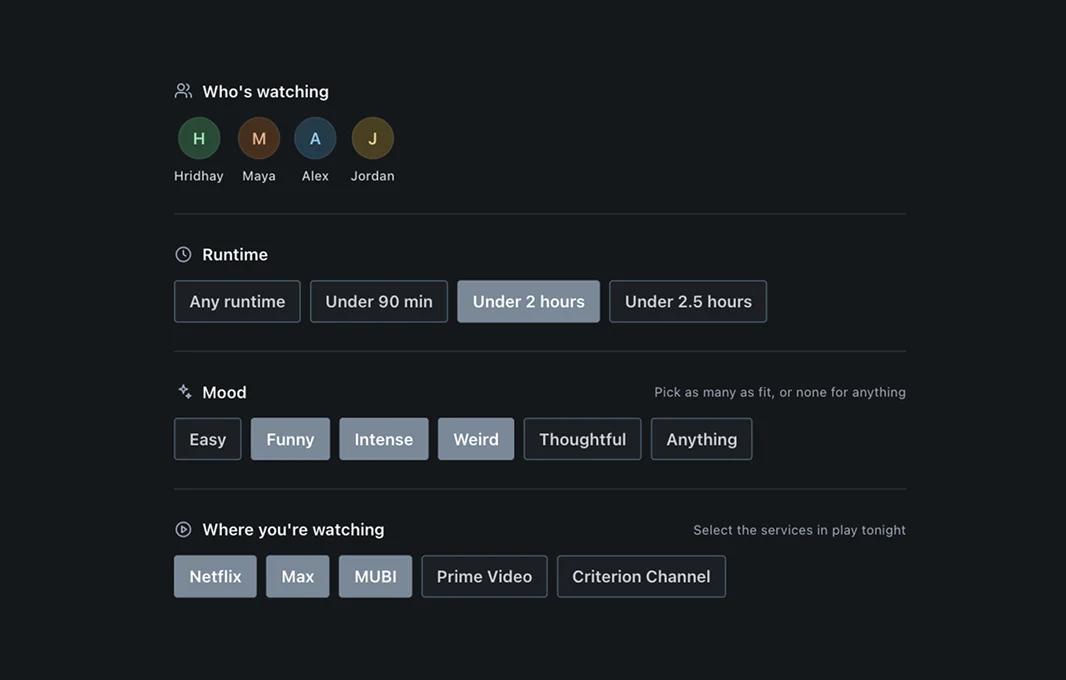
Define tonight
Keep tonight’s needs separate from taste
Runtime, mood, and streaming access describe this session without changing the group’s longer-term taste.

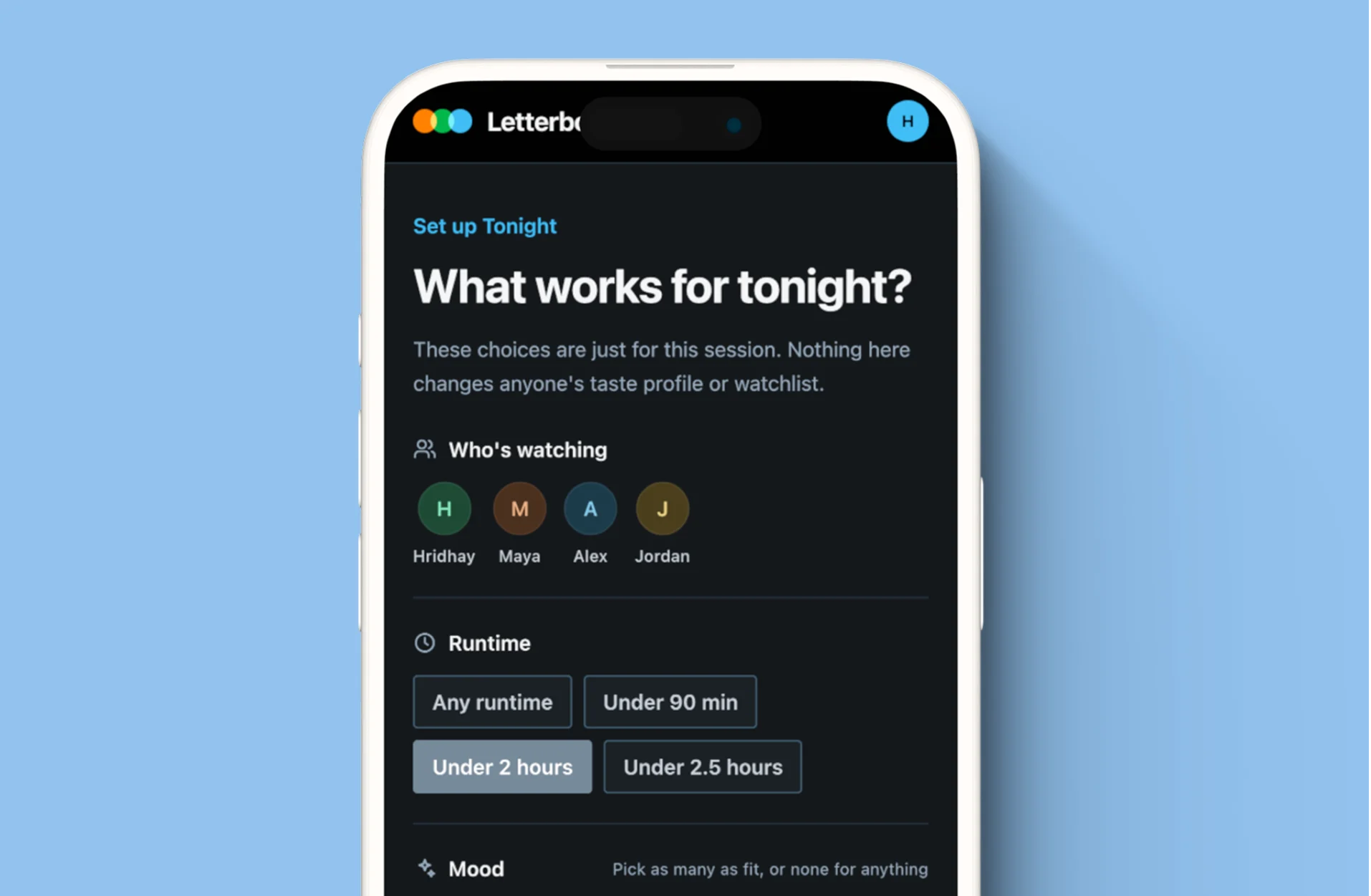
Tonight explores how Letterboxd’s saved films and taste signals could help a group choose what to watch, using the constraints of one movie night. I surveyed 22 members and interviewed seven, then designed a flow that narrows a group’s shared watchlist down to one film everyone feels good about.
Problem framing
Groups already save the films they want to watch, but nothing helps them decide together. Suggestions scatter across group chats and streaming apps, constraints like runtime and access surface late, and rejected films keep coming back. Choosing takes longer than it should, and the final pick often feels like a compromise.
Help a group turn the films they’ve already saved into one choice everyone feels good about tonight?
Mapping the current journey
Spent over 15 minutes choosing
19 of 22 surveyedSwitched tools at least 3 times
17 of 22 surveyedSettled, gave up, or chose a fallback
14 of 22 surveyedWhy I mapped the journey. The survey and seven interviews connected late constraints, lost context, repeated options, and app switching into one decision problem.
“The group wasn’t struggling to discover films. They were switching between tools to eliminate them.”
Contextual interviews
Average reconstructed decision
Fairness
Confidence
Every group named 5–8 films, so the time went into ruling options out: runtime, access and cost surfaced last, and in 4 of 7 journeys a rejected film came back. Fairness scored 4.1/5 but confidence only 3.6, pointing to an evaluation problem rather than a voting one.
Finding the opportunity
Letterboxd already handles finding, saving and tracking films. What it doesn’t have is a place for a group to decide. Tonight branches off the watchlist as a single new path, from setting tonight’s limits to one shared pick, without changing how anyone uses the app today.
Design strategy
Everything the group has saved.
Time, access and mood up front.
Same details for every option.
One film everyone agrees on.
Final design
Define tonight, understand what remains, build a shortlist, and compare finalists using the same evidence.
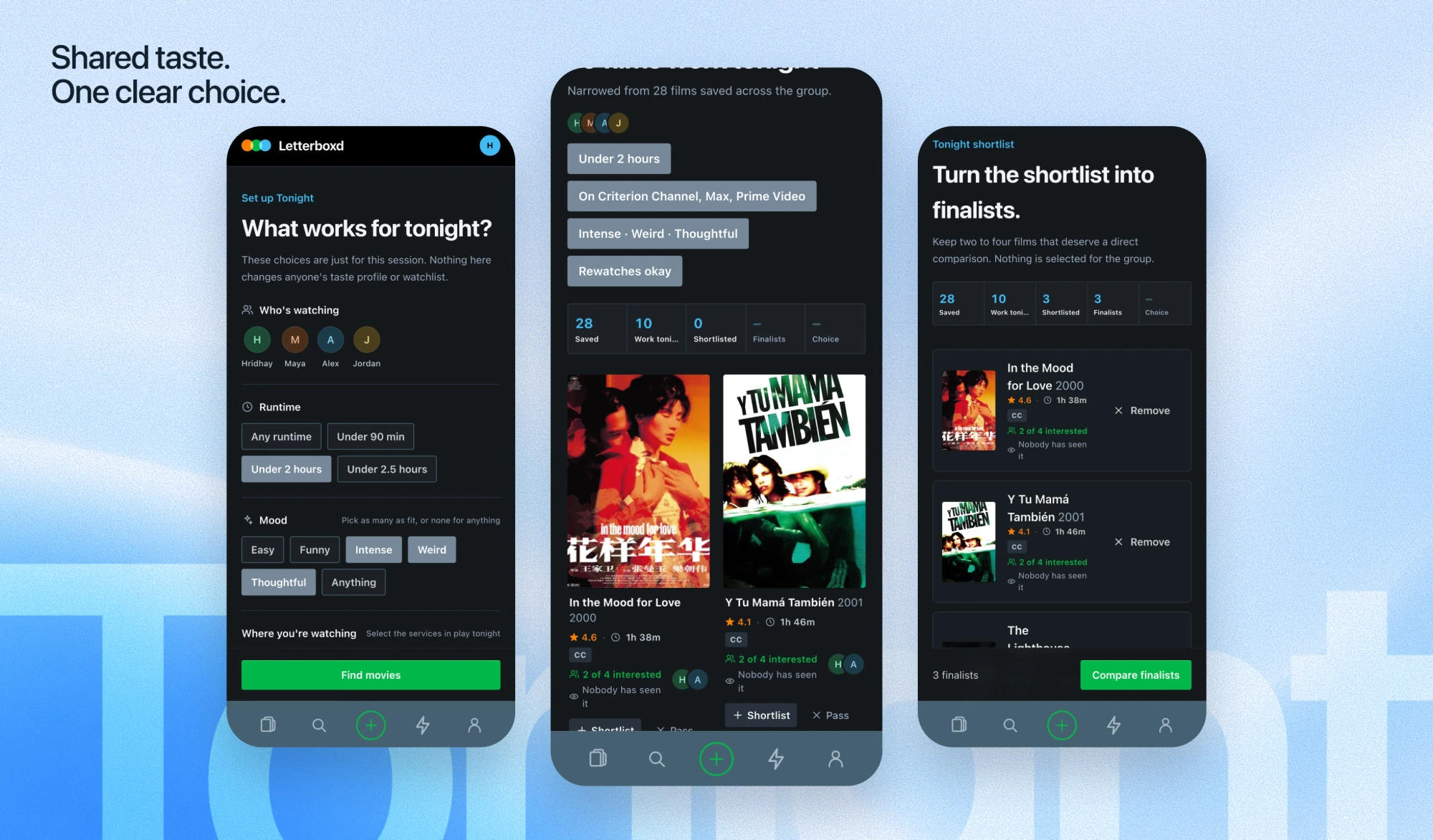
Runtime, mood, and streaming access describe this session without changing the group’s longer-term taste.
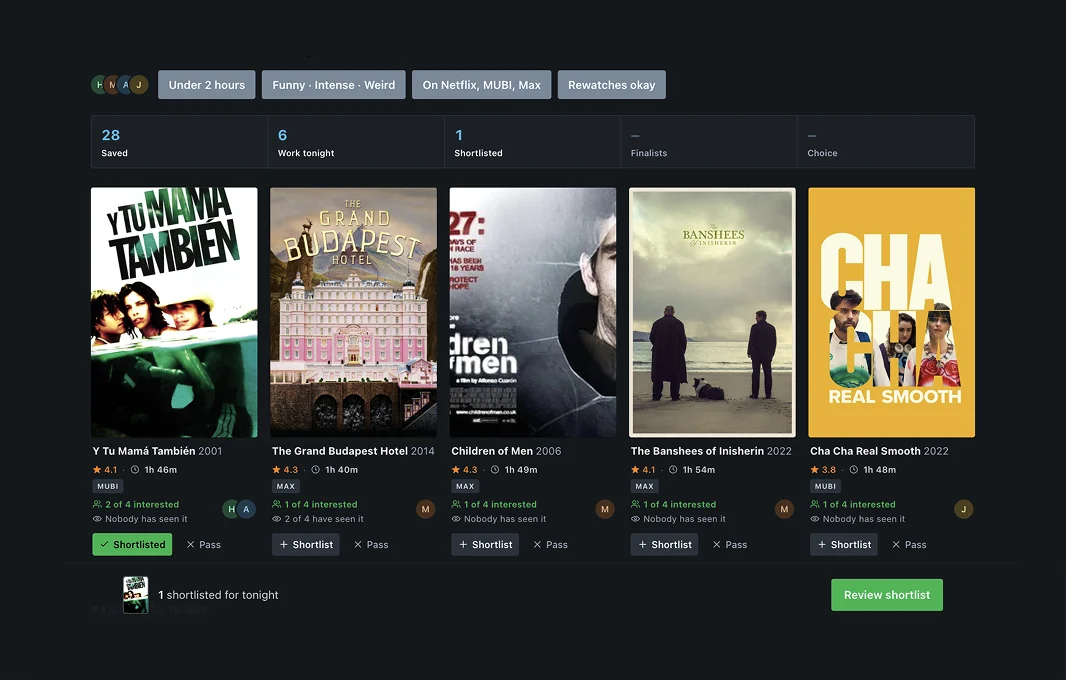
Show the constraints and shared interest behind each candidate so the group can understand why it remains.
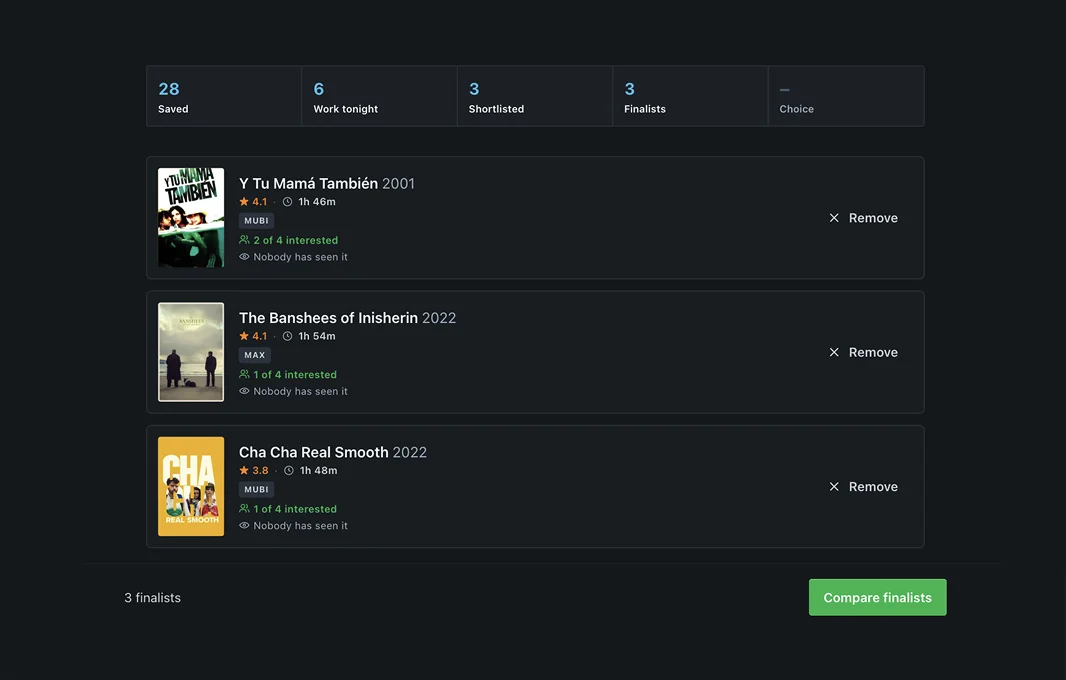
A shared shortlist preserves the discussion as options narrow, reducing the need to repeat suggestions across apps.
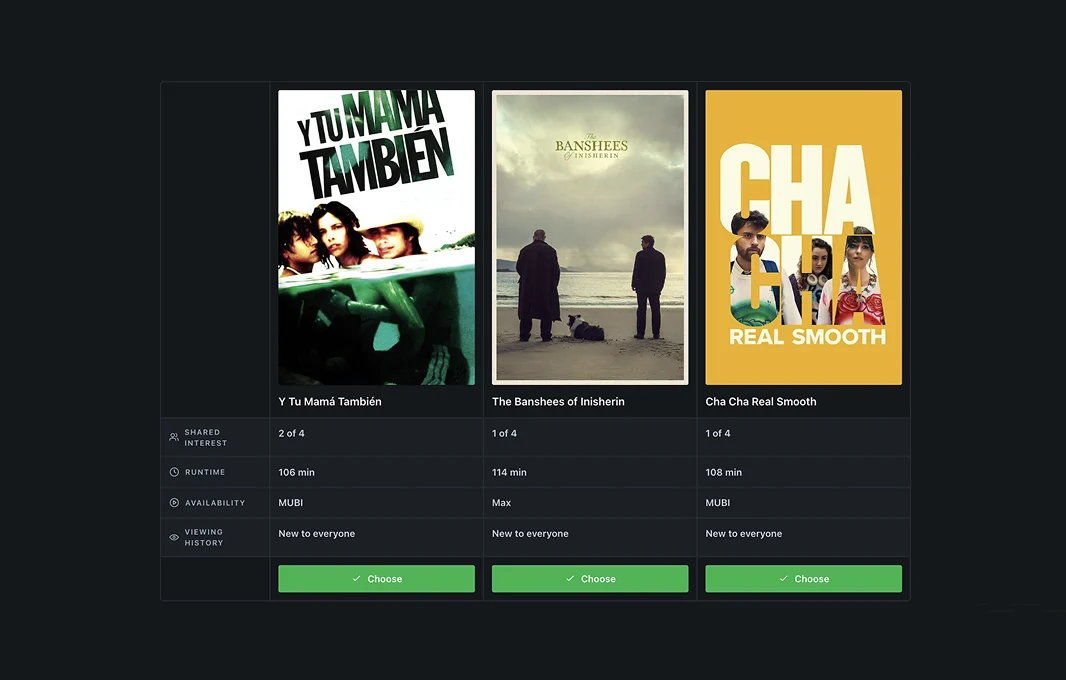
Runtime, availability, shared interest, and viewing history give the group a consistent basis for its final tradeoff.
Reflection
Research shifted the focus from recommending films to helping groups reduce options together. Each step now narrows the set while keeping the reasoning visible.
I would test with real groups earlier, paying attention to turn-taking, vetoes, and whose preferences dominate. The social interaction matters as much as interface clarity.
Compare the normal process with Tonight across time, tool switching, confidence, and fairness. Success means a choice that feels understood and shared—not merely faster.